Montepuez Rubies, One of the Richest Ruby Fields on Earth and the Fight Over Who Digs It
Between 22 and 29 June 2026 Gemfields held its first "Trade Select" auction of rough rubies from Montepuez, in Cabo Delgado's interior west of Pemba. Buyers took 82 of the 89 lots, 348,409 carats in all, for 23.1 million dollars, an average of 66.30 dollars a carat. An earlier Montepuez ruby auction, in February, had brought in about 53 million. Few people outside the gem trade know the name, but Montepuez is one of the most important sources of rubies in the world, and the rubies are one of the reasons Cabo Delgado is fought over.
The discovery
Rubies turned up in the bush near Montepuez around 2009. Within a few years thousands of informal miners, many from other parts of Mozambique and from neighbouring countries, were digging the area by hand. In 2011 the government granted a concession of about 34,000 hectares to Montepuez Ruby Mining (MRM), owned 75 percent by Gemfields, a London-listed company that also mines emeralds in Zambia, with a Mozambican partner holding the rest. MRM began industrial mining and selling its stones through its own auctions, and Montepuez soon supplied a large share of the world's rough rubies.
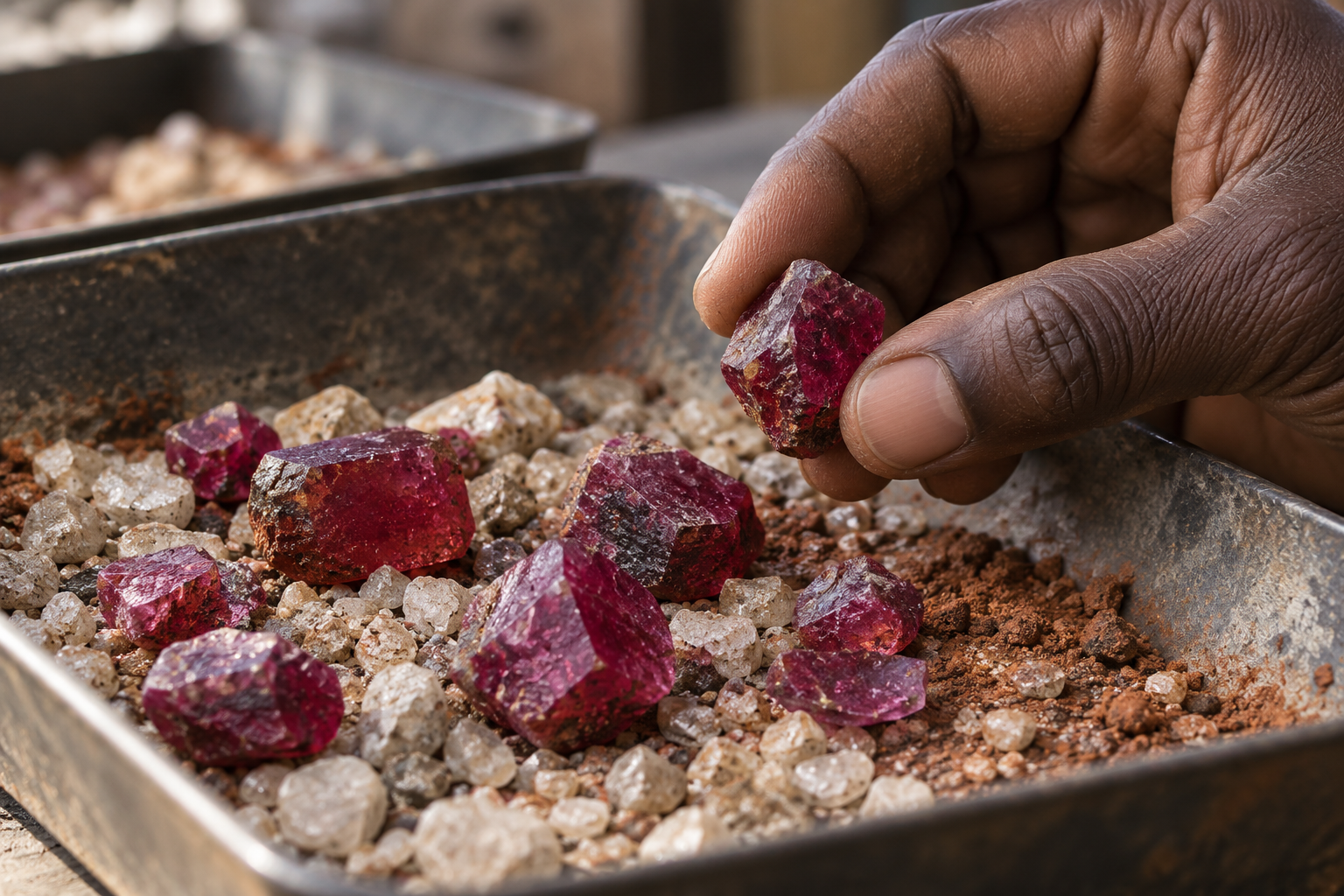
Image: pxef.com
The partnership brought money to Maputo and to shareholders. It also put a fence around a deposit that thousands of local people had already been digging.
The abuses
What followed was ugly. Mozambican police and private security guards working at the concession were accused of beating, shooting and abusing informal miners and residents who entered the area, and of burning villages. In 2019 Gemfields and MRM agreed to pay 8.3 million dollars to settle a case brought in London on behalf of 273 Mozambicans who alleged killings, beatings and other abuses, without admitting liability. They also set up a grievance mechanism.
The tension hasn't disappeared. In June 2026 two people were killed at the Namanhumbir ruby diggings, in a clash between informal miners and an officer of the police Rapid Intervention Unit, according to local reports compiled by the conflict monitor ACLED.
The war comes closer
For most of the insurgency (explained here), Montepuez was a refuge rather than a front: it hosts displacement centres for families who fled the coast. In 2025 and 2026 the insurgents spent long periods in Ancuabe district, between Montepuez and Pemba, and in Chiúre further south, and took control of some artisanal mining sites, a source of income and of people to extort (Cabo Delgado's humanitarian crisis). Their kidnappings for ransom quadrupled in 2025.
Rubies are easy to carry and hard to trace, which makes them useful to anyone who wants to finance a war or launder money. Analysts of the insurgency have long noted that the province's mineral wealth, and the sense that outsiders take it, helped the insurgents recruit young men with no other prospects.
What's next
Gemfields scheduled its next mixed-quality ruby auction from Montepuez for October 2026, and described the coloured-gem market as "challenging" in some segments. For the company, Montepuez is a dependable earner. For Mozambique, it is a source of tax revenue and foreign currency. For the people of Montepuez and Namanhumbir, the question is the same as it is for gas (the gas projects) and graphite (Balama graphite): how much of the wealth stays where it is dug.