Pemba, Mozambique, the Bay City That Became the Wartime Capital and Gas Hub of Cabo Delgado
Pemba was a quiet place for most of its life. A colonial port and provincial capital on a vast natural bay, it was far enough from the wars of the 20th century to come through them largely untouched. It had a cathedral, a small port, a beach strip at Wimbe and a modest name among regional holidaymakers as the gateway to the Quirimbas islands. Then, within a few years, it became three things at once: the staging town for one of Africa's largest gas investments, the refuge for hundreds of thousands of people fleeing an insurgency, and the military rear base for the war against it.
From Porto Amélia to Pemba
The bay itself was known to Swahili and Arab traders long before the Portuguese built anything here. The modern town was founded in the early years of the 20th century by the Niassa Company, the chartered company that ran northern Mozambique for Portugal, and named Porto Amélia after Portugal's queen. It received city status in 1904 and, after the company was dissolved in 1929, stayed on as capital of Cabo Delgado province. Most of the old town had taken its shape by the late 1920s. At independence in 1975 it was renamed Pemba.
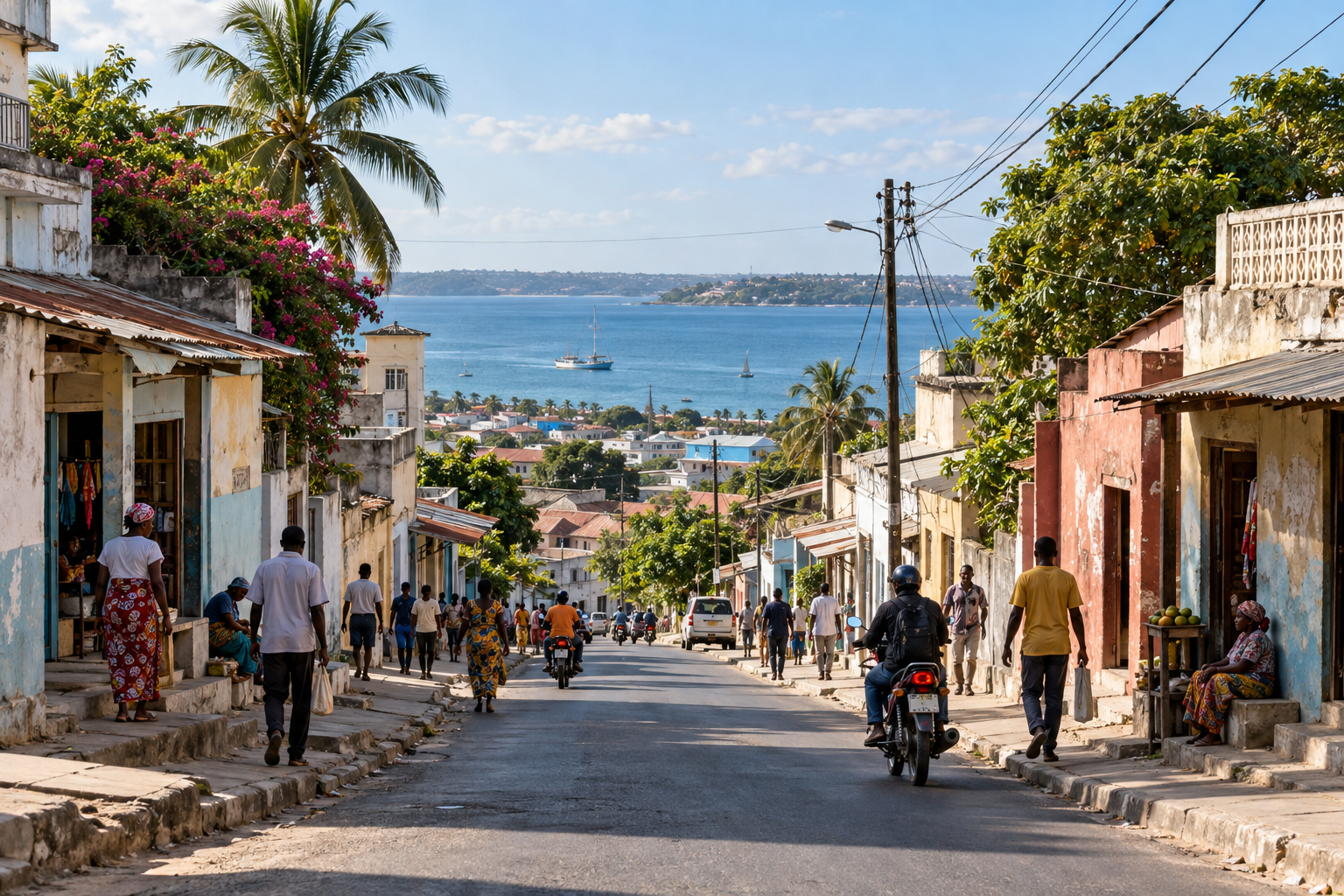
Image: pxef.com
The bay is the reason the town exists. It's a large, deep, semi-enclosed harbour, often described as one of the biggest natural bays in Africa, with a reef protecting its beaches. That harbour is why gas companies base their logistics here (the port and logistics base) and why the Portuguese chose it in the first place.
A city that doubled
Pemba grew fast even before the war. The census counted about 85,000 people in 1997, about 139,000 in 2007 and about 202,000 in 2017. Since then the insurgency has pushed tens of thousands more into the city and the surrounding district of Metuge (the insurgency explained). In 2020 and 2021 the beach at Paquitequete, the fishing quarter next to the old town, became the landing point for boats packed with families escaping the fighting on the coast to the north. Displacement camps grew on the city's edges, and aid agencies set up their provincial operations here.
The result is a city under strain. The provincial government, the army's regional command and the international agencies are all based in Pemba, and the city's economy runs heavily on them.
The gas economy
The decisive change came offshore. The gas discoveries of 2010 to 2013 in the Rovuma Basin turned Pemba into a supply town for Eni, Anadarko (later TotalEnergies) and ExxonMobil (the three gas projects). Hotels filled with engineers, the airport added flights to Johannesburg, and suppliers opened offices. When TotalEnergies froze its project after the 2021 attack on Palma, much of that went quiet. Its full restart in January 2026 (the restart) has brought the contractors back, and Mozambique's June 2026 local content law gives Cabo Delgado firms a legal share of the work (how local firms get in).
Pemba also exports graphite from the Balama mine, inland, through its port since 2024, and sits on the edge of the Montepuez ruby fields, among the richest in the world.
Governing Pemba
Pemba is a municipality with its own elected mayor and assembly, and the seat of the provincial government. Like most of Mozambique it has been governed by Frelimo, the party in power since independence. The 2023 municipal elections and the October 2024 general election were both disputed nationally, and the protests after the 2024 vote, led by the opposition figure Venâncio Mondlane, were the deadliest Mozambique had seen in decades. In Cabo Delgado the politics mix with the war: grievances over land, jobs and who benefits from the province's resources fed the insurgency, and they shape how people in Pemba view the gas boom.
The city for a visitor
For a visitor, Pemba splits into three parts: the old town by the port, with its run-down colonial streets and the fishing beach at Paquitequete; the modern centre, with banks, shops and offices; and Wimbe Beach, about five kilometres east, with the hotels, restaurants and dive shops (the neighbourhoods). The practical details are in our posts on getting there, where to stay and eat and whether it's safe.
Pemba has never been more important to Mozambique, or more crowded.